Short answer: a website for a manufacturer should let engineers and buyers find the exact product, check its specifications and download the datasheet without phoning anyone. It then needs to turn that interest into a precise quote request. That means indexable product pages built from your product data, clear evidence of capability and certification, and versions for your export markets.
Who visits a manufacturer’s website, and what are they checking?
Three groups, each with a different question.
Engineers and specifiers want data: dimensions, ratings, materials, tolerances, standards met, and often drawings or CAD files. They search by part number or specification, not by your brand name. A typical query is “IP65 linear LED fitting 1500 mm”.
Procurement and buyers want commercial facts. They check minimum order quantities, lead times, packaging and Incoterms. They also ask whether you’ve supplied similar companies or markets. They’re building a shortlist and want to reduce risk.
Distributors and partners want to know whether you work with distributors in their country, what support you give, and who to speak to.
All three check whether you look established. They look for a real address and photos of your production floor, not stock factory images. They look for certifications such as ISO 9001, if you’re certified. They also look for product markings where they apply, such as CE marking for the EU or UKCA marking for Great Britain. Only show certificates and marks you hold, and keep expiry dates current.
Should the catalogue live in a PDF or on the page?
Both, but the page comes first. A PDF catalogue is useful for buyers who want to print or forward it. On its own, though, it is a poor sales channel. Search engines can’t match a search for one product to page 47 of a PDF. Buyers on phones won’t zoom through it. Your sales team can’t send a link to one item.
A proper catalogue gives every product, or every product family, a page with:
- a clear photo on a neutral background, plus an application photo
- a specification table, with variants, codes and options
- downloads: datasheet, certificate, installation guide, CAD file where available
- related products and accessories
- a “Request a quote” button that carries the product code into the form
Structured data on those pages helps search engines understand them. If the data lives in a spreadsheet or an ERP export, we import it rather than retyping it. That keeps updates manageable.
What makes a quote request useful to your sales team?
A form that just says “Message” produces vague emails. A B2B quote form should ask for the product code (pre-filled), quantity, required specification or options, delivery country, timeline and company details. Your sales team then knows whether it’s a sample order or a production run before replying.
Custom and OEM work needs its own route. Explain what you can make to specification and the information you need, such as drawings, volumes and materials. Then explain how the development process works.
Example: Valkov Technosvet
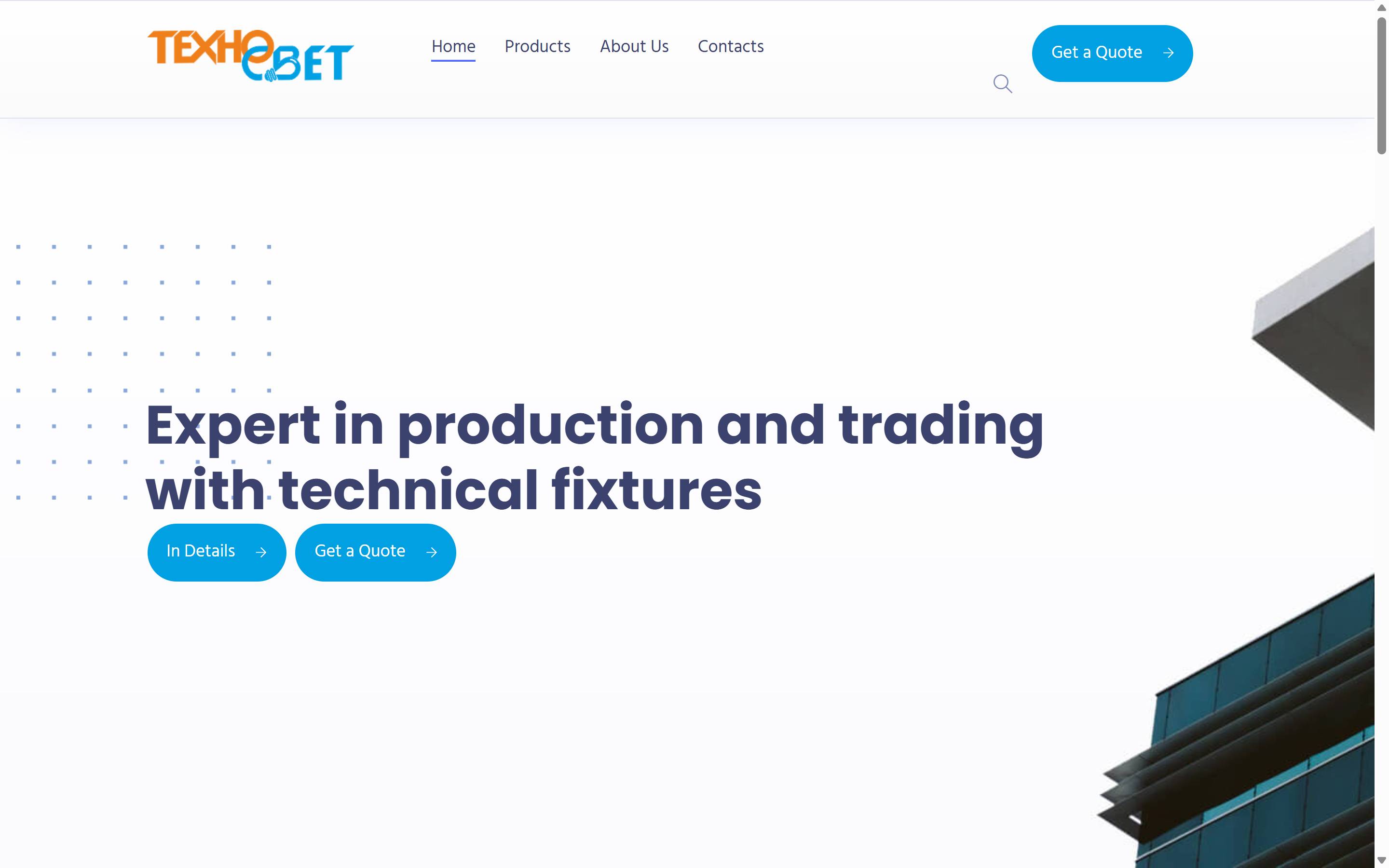
technosvet.com is the English-language site we built for a lighting manufacturer in Stara Zagora, Bulgaria. It’s organised around a product catalogue by series. Each product page has a technical description, a table of codes and wattages, and related models. The full catalogue is available as a PDF, and “Get a Quote” sits in the header of every page. The case study covers the structure.
Preparing your product data
The catalogue is only as good as the data behind it. Before the build, gather a spreadsheet of products with codes, series and key specifications. Add current datasheets, product photos, certificates with expiry dates, and your export markets in priority order. Avoid machine translation for technical pages: a mistranslated rating can lose a buyer’s trust.
A standard-size catalogue fits the plan of €0 upfront and €150 a month excl. VAT for 24 months. Very large catalogues or ERP links are quoted separately. If you also want to sell standard items directly, see online store development; for portals or configurators, see web apps. Or tell us about your catalogue.