Short answer: A construction company website should get you onto a client’s shortlist and keep you there. Show finished projects similar to theirs, and explain what each service involves and how you run a job. Prove you’re insured and accountable, and make it easy to request a visit. It is a long decision, so the site must hold up to repeat visits.
How is a builder actually chosen?
There are really two kinds of construction enquiry. Small, urgent jobs (“roof leak repair”, “damp specialist near me”) behave like any emergency trade: the person rings whoever looks credible and available. Large projects behave differently. Someone planning an extension, a loft conversion or a full renovation searches “house extension cost”, “loft conversion [town]” or “builders near me reviews”. They read for weeks and collect three quotes. Then they compare how each builder communicated as much as the numbers.
During that period your website is visited repeatedly, by the client and often by a partner or relative they show it to. Each visit, they look for reassurance: have you done this type of job before, at this scale, nearby; will you turn up; what happens if something goes wrong. A gallery of nice photos answers only the first question.
Commercial and public clients add another layer. They want company details, accreditations and health and safety information before they will even invite you to tender.
The pages that win the shortlist
- Case studies, not just a gallery. For each project: what the client wanted, the scope, the area, roughly how long it took, problems solved and photos from start to finish. Three good case studies outweigh fifty unlabelled pictures.
- Service pages with real scope. An extension page explains planning, structural design, building control sign-off and who arranges each. A renovation page explains sequencing and living on site during works.
- Your process. Survey, quotation, contract, schedule, payment stages, handover and snagging. Clear stages reduce the fear of overruns, which is the main anxiety in this market.
- Credentials and paperwork. Public liability insurance, any insurance-backed guarantee you offer, company registration and trade body membership. In the UK, schemes like TrustMark or the Federation of Master Builders carry weight, but only list what you hold.
- A low-effort contact route. Many people won’t fill in a long form until they trust you. A phone-number-only callback form, plus a fuller “request a quote” form for those ready, covers both.
Which mistakes cost builders the job?
Listing every trade under the sun so the firm looks like it does everything and specialises in nothing. Photo galleries of 8 MB images that never load on site wi-fi. A “projects” page last updated years ago. Service-area pages duplicated for twenty towns with only the name swapped. And skipping the legal side. In the UK, domestic clients often don’t know that the contractor or principal contractor normally takes on their duties under the CDM regulations. Many also don’t know how party wall notices work or who serves them. A short, accurate explanation (checked by you) sets you apart from firms that stay vague.
Respect 4: a site we built in this sector
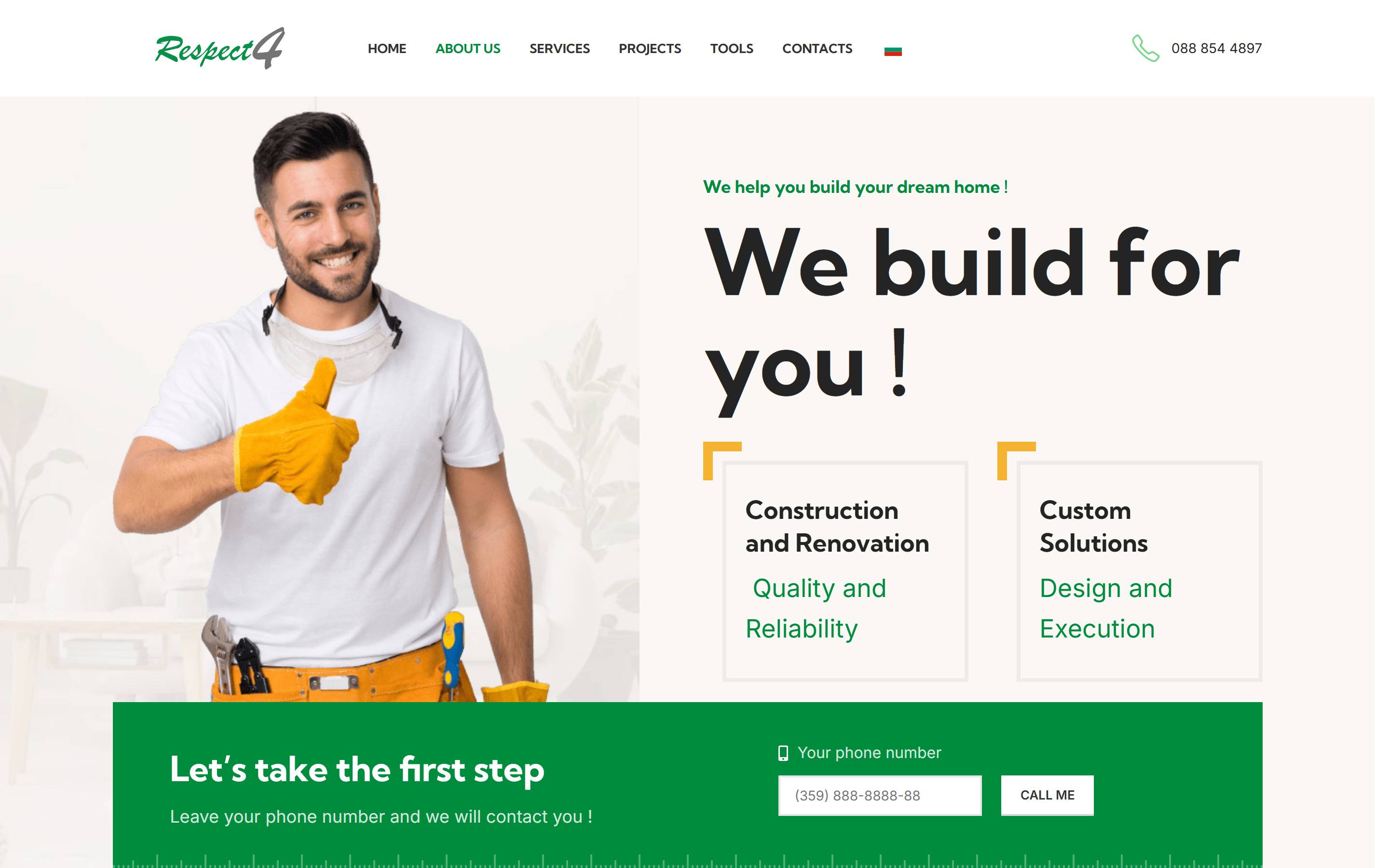
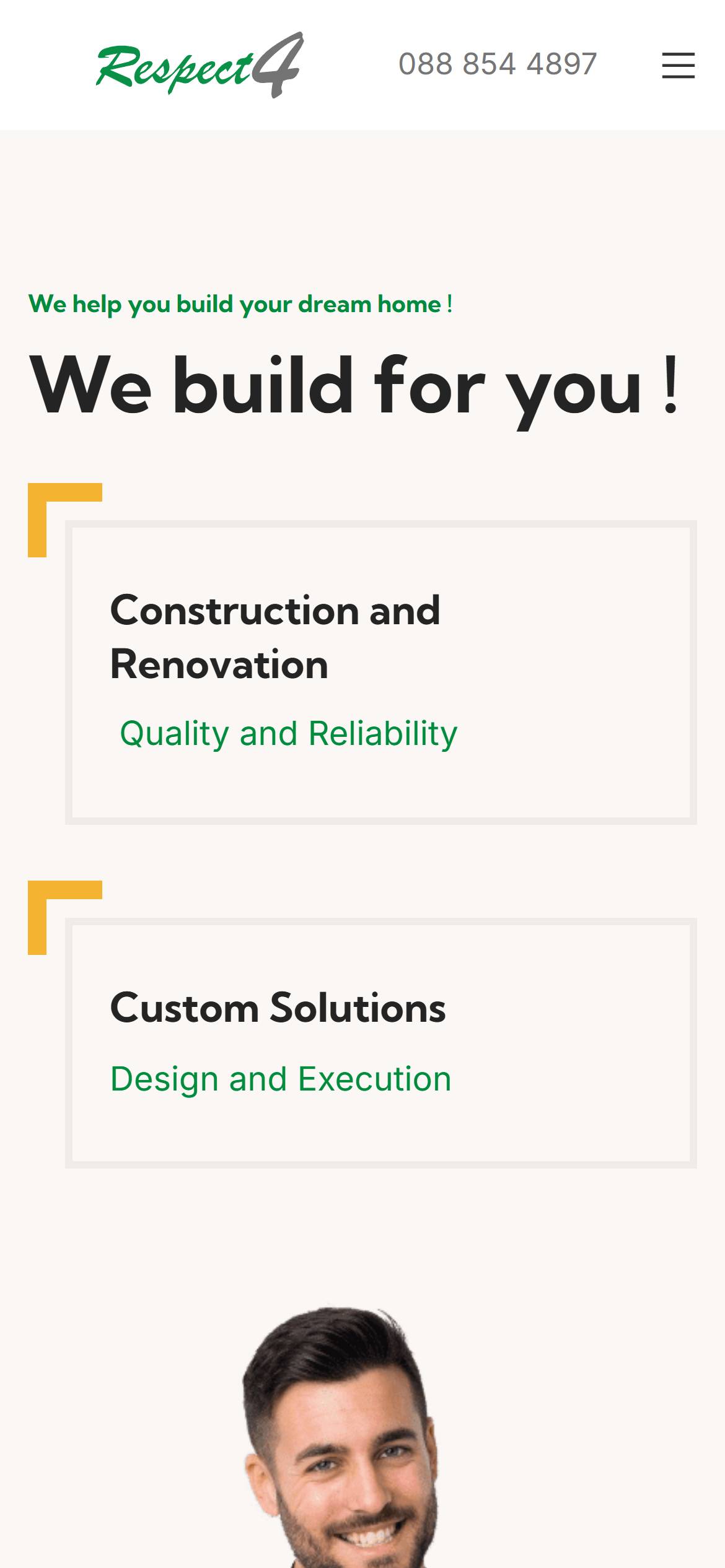
respect4.bg is a construction and renovation company, so it is a direct comparison. It is a single-page Bulgarian/English site built around one action: leaving a phone number. The callback form appears at the top and bottom, the header number dials with one tap, a gallery shows projects at different stages, and separate sections cover tools, materials and scaffolding hire. The case study has the detail.
Before the build
Pick three to five projects you’re proud of and gather photos, a short brief and the location for each. List your services in order of what you want more of, your service area, insurance and memberships, and the stages of your process. Sites usually launch 7–10 days after content arrives. The monthly option starts at €0 and runs at €150 a month excl. VAT.
Use the website preparation checklist, weigh a monthly plan against a one-time build, or arrange a call.